Three of Apple’s phones will release with 5G connectivity next year with Qualcomm’s X55 5G modem, Nikkei reports. This modem will reportedly be paired with a new Apple chipset — likely to be called the A14 Bionic — that’ll be the first from the company to be built using a 5-nanometer process. In general, moving to smaller manufacturing processes makes chips more efficient while allowing more processing power to be packed into a smaller space.
This isn’t the first time we’ve heard rumors that Apple is planning on releasing its first 5G phones in 2020, nor is it the first time we’ve heard there’ll be three of them. Apple analyst Ming-Chi Kuo made a similar prediction back in July. What’s new are the reports of the exact Qualcomm modem Apple plans to use after the two companies settled their ongoing legal dispute back in April. In the longer term, Apple is thought to be working on its own in-house modems having acquired the majority of Intel’s smartphone modem business in July.
The report also corroborates previous rumors that Apple is planning to switch to a 5nm fabrication process for its chips next year, moving away from the 7nm process that it’s used since the A12 Bionic chip debuted in 2018. Apple rival Huawei is also thought to be working on a 5nm chip of its own that’s set to launch in a similar period next year.
Today, Snapchat is introducing a new 3D Paint feature that lets you draw in augmented reality. You can use it to draw on your own face using your phone’s front-facing camera, and it’ll also work with your rear-facing camera to let you to draw on objects in the environment. One video produced by Snap shows the feature being used to draw a pair of eyes and a mustache on the front of a van.
The functionality looks similar to Samsung’s “AR Doodle” feature which it introduced with the Galaxy Note 10. However, Samsung’s feature has the added benefit of using the phone’s S Pen stylus, which should be more precise than drawing with your finger on the screen.
If you want to give the feature a go yourself, then Snapchat’s 3D Paint is rolling out starting today. You’ll be able to find the feature within the Create section of the iOS app’s AR Bar. Unfortunately, the feature isn’t available on Android at launch, but Snapchat says that it will be coming to the platform in the coming months.
Sony has announced as part of its second-quarter earnings report that it sold 2.8 million PlayStation 4 consoles between July and September. Since the company hit exactly 100 million sales three months ago, the total is now at 102.8 million, meaning the PS4 has outsold the original PlayStation.
The PlayStation, as you may remember, was an enormous success. It sold 102.5 million units, vastly more than competitors like the Sega Saturn and the Nintendo 64, and until now it was the second best-selling home console of all time behind the PS2, which sold a probably unrepeatable 155 million. Also of note: the Nintendo Wii’s total of 101.6 million has been surpassed this quarter as well.
It’s a huge achievement for Sony to attain this level of popularity with the PS4, but this console cycle is clearly winding down. Sony’s gaming revenue is down 17 percent year on year, with profit down 28 percent, which isn’t a surprise given that the company plans to release the PlayStation 5 next holiday season. But Sony has revised its PS4 hardware sales forecast for the fiscal year down to 13.5 million units, a reduction of 1.5 million.
The PS4 isn’t done quite yet, however. Major exclusive games on the calendar include The Last of Us Part II, Ghost of Tsushima, and next week’s long-awaited Death Stranding.
The original AirPods on the left, the new AirPods Pro on the right.
Sarah Tew/CNET
In case you hadn't heard, Apple is releasing a new set AirPods on Wednesday. They're called the AirPods Pro, they cost $249, and they deliver two new features to Apple's headphone line. They're the first AirPods to feature a noise-isolating design -- with silicone ear tips that push into your ear canal -- and the first ones to offer active noise-canceling, which electronically blocks external noise. I got an early review sample and took the new AirPods for a spin in the noisy streets of New York City, then brought them back to the office for some further listening. Here are my early impressions.
They fit comfortably and securely
I'm one those people with ears that aren't ideal receptacles for the original AirPods, which are now on their second generation. I can wear them, but they don't stay in my ears all that well. I feel them start to fall out if I do anything too strenuous in them, like dash across the street to make a light or catch a bus, which you sometimes have to do in New York City.
With the AirPods Pro, I have no such problem. They fit my ears securely. I can run with them -- and they're sweatproof, Apple says. It's also worth noting that they come with small, medium and large ear tips. I was worried I would need an extra large tip to get a tight seal, but the AirPods Pro's large ear tips fit my ears just fine.
The long and short of it is the new design will fit more ears than the original AirPods. I hesitate to call it a universal fit because there are always exceptions, but they're close. The only issue is that some people simply don't like having silicone buds stuck in their ears, even if they're as soft and pliant as Apple says these tips are. That's the reason why so many people like the original AirPods. They just sort of nestle in your ear -- and when they fit right, they're really comfortable. A few people in the office I talked to said that even though the AirPod Pros sounded better, they still preferred the fit of the regular AirPods.
Now playing:Watch this:
AirPods Pro first impressions: Should you upgrade?
8:18
They sound better
The first thing you notice about the AirPods Pro is that they simply sound better than the standard AirPods. Thanks to their noise-isolating design and new drivers that are tuned for that design, they clearly have a lot more bass and richer sound. Also, thanks to the noise-cancelling, which is effective, they sound a lot better in noisier environments like city streets. The standard AirPods sound decent in quiet places but due to their open design, they just don't do well when confronted with external noise. It can literally drown out your music.
The Ear Tip Fit test helps determine which size is right for your ears.
Sarah Tew/CNET
They're even better for making calls
The standard AirPods are quite good for making calls. With the release of the second-generation model this year -- some call them the AirPods 2 -- Apple improved their noise-reduction capabilities, particularly wind noise. The AirPods Pro have three microphones on each bud, one of which is a beamforming mic that's designed to pick up your voice. They also have similar noise reduction capabilities, plus a vent system that's not only supposed to relieve some of the pressure that can build up in your ear from a noise isolating design coupled with noise-cancelling, but can help cut down on wind noise a tad, an Apple rep told me. More importantly, you can simply hear callers better because of the Pros' noise-isolating design.
They don't sound better than the Sony WF-1000XM3 -- but they're smaller
I compared the AirPods Pro to its closest current competitor, the Sony WF-1000XM3, which also has adaptive noise cancelling. The AirPods Pro sound excellent for true wireless earphones, but the WF-1000XM3 arguably sounds a little better -- bigger and smoother overall, with slightly warmer sound, they're more pleasant to listen to for longer listening sessions. The Sony WF-1000XM3's noise cancelling is also as effective as the AirPods Pro's noise cancelling. And the Sonys battery life is rated a little higher. In active noise cancellation mode, Apple says AirPods Pro will deliver up to four and a half hours of listening.
All that said, the AirPods and their charging case are significantly smaller than than the Sonys. The charging case is wider than the standard AirPods' case and a little thicker, but it's still a very small package. And size matters when it comes to these types of earphones. The case and the AirPods are literally half the size of the Sonys. There's something very appealing about that.
The Pros have shorter stems.
Sarah Tew/CNET
The stems are shorter and I like the new controls better -- but there are still no volume controls on the buds
The standard AirPods have touch controls. You tap or tap-and-hold a touch zone on the side of the bud. The AirPods Pro have a force sensor in the stem of each bud -- and the stems are shorter, which is good. You pinch the stem to activate the controls. Pinch twice quickly to advance a track forward. Press-and-hold to toggle between noise cancelling on or off or a transparency mode that allows sound to leak in (so you can hear train announcements, for example). You can also program the press-and-hold function to call up Siri manually if you don't want the always-on (hands-free) Siri feature to be active. Like the AirPods, the Pros have Apple's H1 chip that allows for always-on Siri, so you can call up Apple's voice assistant simply by saying "Hey, Siri."
Apple says the air vents on the inside of the buds help release some pressure.
Sarah Tew/CNET
It's worth spending the extra $50 on the AirPods Pro instead of buying the AirPods with Wireless Charging
If you like your current AirPods and they fit your ears well, you don't need to run out and buy the Pros (I'd wait for your AirPods to die, which they will sooner rather than later if you use them a lot). But if you've been eyeing the $199 AirPods with Wireless Charging, I'd pass them by and go straight to the Pros. The Pros have a wireless charging case too, and their superior sound and added features are worth the extra dough.
The big question will be how low will the standard AirPods (without wireless charging go). They list for $160 but they often cost less and we've seen for them for as low as $130. As their price creeps down, I'd say those are the AirPods to get if you don't want to spend too much money on AirPods. Forget the wireless charging. It's an overrated feature and should cost less.
The Beats Powerbeats Pro are in trouble
A lot of people were looking for better sound and a more secure fit than the AirPods and they both in the Beats Powerbeats Pro. Apple, of course, owns Beats, and the Powerbeats Pro have big bass and dynamic sound as well as long battery life in a sporty design. They also cost $250 but have lately been selling for $200 (that probably should have been a tip off that the AirPods Pros were coming). The Powerbeats Pros are still a very good true wireless headphone but the big strike against them is their bulky charging case. With their sweat-resistant design, bolder sound, and more secure fit, the AirPods Pro are clearly a direct competitor. The smaller size and more discreet profile of the AirPods Pro makes them the more appealing choice than the Beats.
Of course, there's plenty more to talk about when it comes to the AirPods Pro, and I'll post my full review after further testing and comparisons. But suffice to say for now, they're going to be at the top of a lot of wish lists this holiday season.
Perhaps unsurprisingly, given their higher price than the standard AirPods, it'll cost more for you to repair or replace the new AirPods Pro through Apple Support. Out of warranty, the price this time around is $89 per earbud, and it costs the same to have the wireless charging case repaired or replaced. If you lose an AirPods Pro earbud, Apple charges $89 for a new one or $99 to replace a misplaced case.
For comparison, it costs $69 to replace or repair an AirPod, $59 for the regular case and $69 for the wireless charging case. AirPods Pro cost $249, while AirPods are priced at $159 or $199, depending on whether you opt for the wireless charging case.
However, the replacement and repair costs drop quite a bit if you have AppleCare+ for Headphones (which costs $29/year). Under that plan, Apple charges $29 for each repair or replacement of all its earbuds and cases.
All products recommended by Engadget are selected by our editorial team, independent of our parent company. Some of our stories include affiliate links. If you buy something through one of these links, we may earn an affiliate commission.
We’ve heard a number of reports of the iPhone 11 beating expectations in terms of early sales. A new supply-chain report today backs the idea that it’s the base model that is leading the way.
That always seemed a likely bet, with the LCD model arguably offering the best bang for the buck, and relatively few reasons to opt for the more expensive Pro model …
NordVPN
Differences between the iPhone 11 and iPhone 11 Pro
The executive summary is that you have to have a good reason to buy the $999+ model over the $699+ one. Many of the specs are mirrored.
Both get the new ultra-wide camera, Night mode, video recording capabilities, and close-to-identical still photography features. The only difference here between the two is that the Pro model gets you the 2x telephoto lens.
The Pro does have the better screen — OLED versus LCD, and higher DPI — but the base model display is still excellent. The slightly thicker bezels would be noticeable if coming from the iPhone X or XS but not really otherwise.
The Pro has the lovely textured matte glass back and stainless steel chassis, versus conventional glass and aluminum, but most people use a case, so that’s not a huge benefit in practice.
The Pro has slightly better water resistance (4m versus 2m) and the option of a 512 GB storage tier (versus 256 GB), as well as an extra hour of battery life.
For me, personally, I couldn’t downgrade to the larger bezels, and I use the telephoto lens a lot, but my recommendation to friends has been to go for the base model, unless one or more of the differences really jumps out at you as worth the price premium.
Base model iPhone 11 beating expectations
A CIRP report last week suggested that, in the US at least, the base model iPhone 11 was selling almost as many units as the Pro and Pro Max combined.
Its data suggests that sales of the latest models were split approximately:
iPhone 11: 9%
iPhone 11 Pro: 6%
iPhone 11 Pro Max: 4%
Supply-chain sources cited by Digitimes today suggest Apple is boosting production of the LCD model.
Apple reportedly has ramped up component orders for its LCD-based iPhone 11 that has seen better-than-expected demand but reduced those for iPhone 11 Pro Max that has seen flat sales, according to sources from Taiwan’s IC supply chain.
This morning, we're learning the punctuation for Apple's most professional set of AirPods and preparing for the launch of Apple TV+ on Friday. We have another new Star Wars trailer to watch for The Mandalorian, and Uber's speedy food delivery drone is ready to show off all of its rotors.
Later today we'll learn more details about HBO Max, and Apple TV+ launches November 1st, so how can Disney keep our attention on its streaming service? A flashy new The Mandalorian trailer with even more rambling voiceover from Werner Herzog will just about do it and provide a good reminder that Disney+ is about to launch on November 12th.
In other Star Wars news, the team of David Benioff and D.B. Weiss is officially off a planned trilogy of movies. We were expecting to see the first one in 2022, but the former Game of Thrones showrunners are apparently far too busy with work related to their $200+ million Netflix deal.
To little fanfare, Apple has snuck out its AirPods sequel, and they're shorter with even more features crammed inside. The main one is noise cancellation, with two microphones on each earbud, and software that continuously adapts the level of active noise cancellation to your ears -- monitoring up to 200 times per second. One microphone keeps tabs on ambient noise, and the other faces inward to pick up any additional sound that may remain. These upgraded buds are also IPX4 rate, so they should hold up just fine to sweat during your workouts. The AirPods Pro will ship on October 30th for $249.
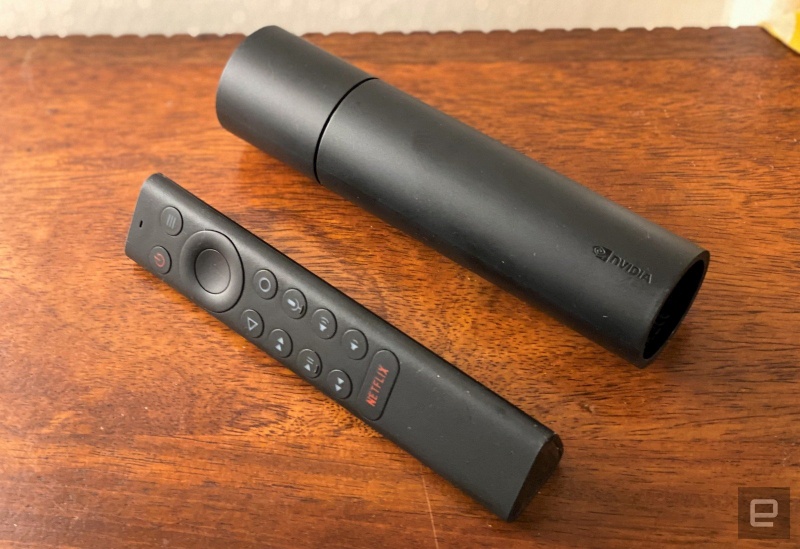
After a slew of leaks, the $149 Shield TV and $200 Shield TV Pro are on sale for you to buy right now. Besides an odd cylindrical shape for the cheaper device and a funky triangular remote, they feature Dolby Vision and Atmos decoding support plus AI-powered upscaling, all powered by a Tegra X1+ chip inside.
The latest update to iOS 13 is here, and it adds the "computational photography" feature, Deep Fusion, which is Apple's answer to Google and Night Sight. It takes advantage of machine learning and image stacking to render each pixel of a photo optimally. You'll likely see the benefits of Apple's new approach most in less-than-ideal lighting conditions, but it should help to improve all your photos. The update also adds 70-or-so new emoji, and if you have a HomePod, it's ready to recognize voices for multiple people in the home and handle audio Handoffs with iPhones.
Intel has revealed that its special edition Core i9-9900KS processor will be available on October 30th at a recommended price of $513. If you recall, this is really a top-binned version of the 9900K, which can reach a 5GHz turbo speed across all eight cores rather than one and hit a base speed of 4GHz instead of 3.6GHz.
The ride-hailing company, which has been expanding its repertoire recently, unveiled a new design for its food-delivery drone at the Forbes 30 under 30 Summit. Uber's drone design has rotating wings with six rotors "for increased speed and efficiency" and can carry meals for up to two people. The idea is that it would carry food quickly from a kitchen to somewhere else (like the conveniently located and easily accessible parking lot that so many restaurants lack) where a driver would grab the package and complete the delivery.
All products recommended by Engadget are selected by our editorial team, independent of our parent company. Some of our stories include affiliate links. If you buy something through one of these links, we may earn an affiliate commission.