Selasa, 30 Juli 2019

Apple earnings Q3 2019 - CNBC

Apple reported earnings for its June quarter on Tuesday that were above expectations, and the company's revenue returned to growth after two straight down quarters.

The stock rose more than 4% in after-hours trading.

Apple's guidance was strong and beat analyst expectations, suggesting that demand for Apple products is stabilizing headed into the critical second half of the year. Apple also declared a cash dividend of $0.77 per share. 

Here's how the company did versus what analysts were expecting:

  • EPS: $2.18 vs. $2.10 estimated by Refinitiv consensus estimates.
  • Revenue: $53.8 billion vs. $53.39B estimated by Refinitiv consensus estimates.
  • Q4 Revenue guidance: $61 billion to $64 billion versus $60.98 billion estimate by Refinitiv consensus estimates.
  • iPhone revenue: $25.99 billion vs. $26.31 billion estimated by FactSet.
  • Services revenue: $11.46 billion vs. $11.61 billion estimated by FactSet. 

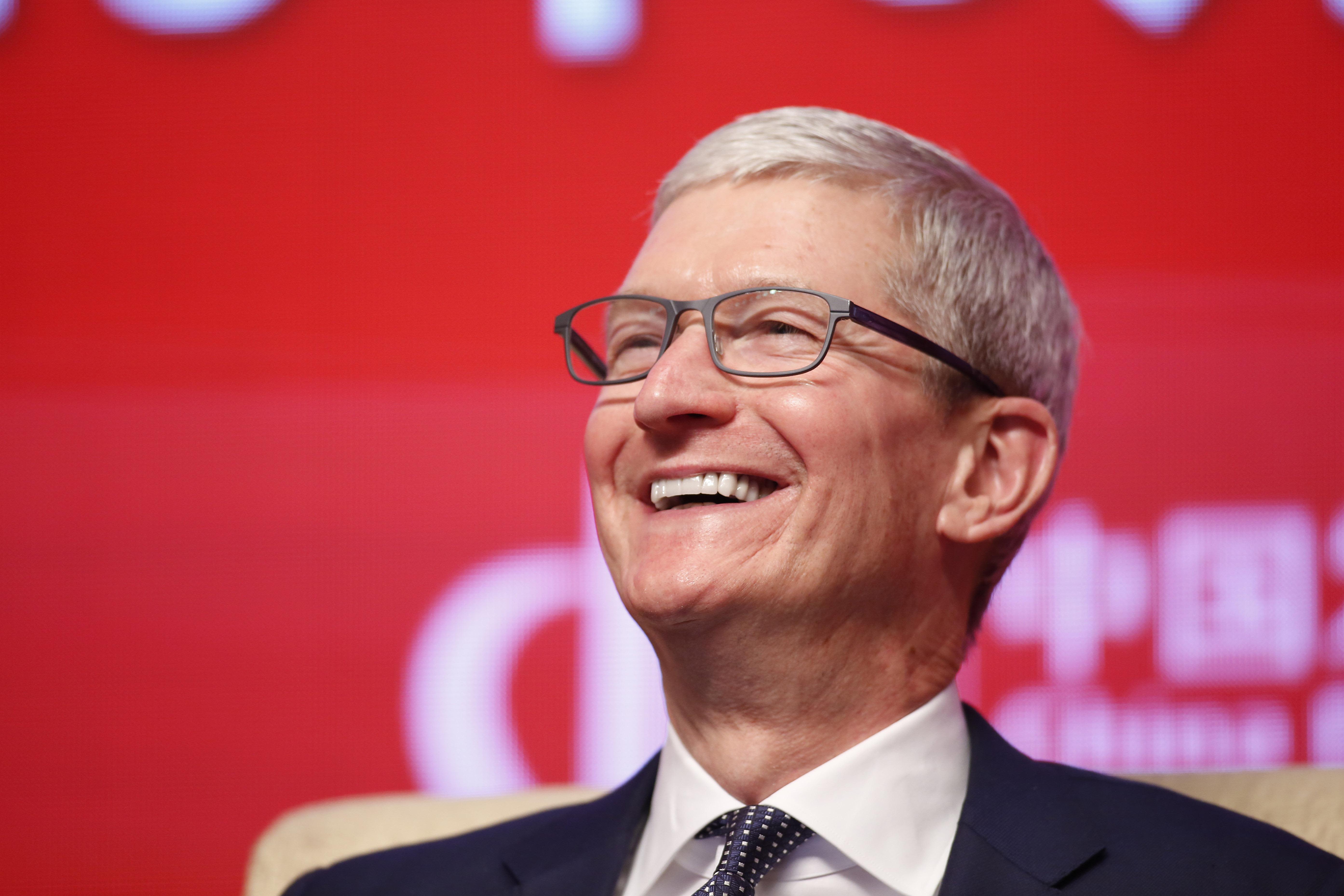
"We're very excited to report a return to growth for the quarter, and it's a record revenue for Q3 as well, best we've ever had," Apple CEO Tim Cook told CNBC's Josh Lipton.

Apple's revenue was up 1% from the year-ago quarter. Earnings per share were down 7%. 

"Great services quarter, unbelievable wearables quarter, significant progress on iPhone, and off-the-charts significant progress on China, compared to where we were the previous quarter," he continued.

Apple said that it had spent over $17 billion on share buybacks of almost 88 million Apple shares, and had also paid out $3.6 billion in dividends and equivalents during the quarter. 

Strong wearables and services growth

Apple's iPhone revenue was slightly lower than what analysts expected, partially offset by strength in the Mac and Wearables divisions. The iPhone accounted for 48.3% of Apple's overall revenue, the first time that it hasn't contributed over half of Apple's sales since 2012. 

Apple's wearables business includes Apple Watch, AirPods, and Beats headphones. In a statement, Apple CFO Luca Maestri said the product category was "accelerating."

Services revenue, which includes subscriptions, App Store fees, and other online services, grew by 13%, slightly under analyst expectations. Services margins were over 64%, contributing to Apple's bottom line. 

Cook said in a statement that Apple plans major launches for several new products in the second half of 2019. 

Critical Chinese market

Apple also outperformed expectations in China, which had been one of the main factors in disappointing quarters earlier this year. Cook said in an interview with CNBC that a Chinese VAT tax cut had been a big help, and that he saw no signs of a nationalistic boycott of Apple products in China.

"The VAT reduced from 16% to 13, that's clearly a big help. We took some price action, that's a big help. We introduced trade-in and financing, that's a big help. The more subjective thing is, when the countries are meeting and talking, that's better than not," Cook told CNBC. 

Apple said that it had $9.61 billion in sales in its Greater China category, which also includes Taiwan and Hong Kong. Cook said that Apple returned to growth in mainland China. 

Let's block ads! (Why?)


https://www.cnbc.com/2019/07/30/apple-earnings-q3-2019.html

2019-07-30 19:50:39Z
CAIiEL2bn7Qk7vkwpvBXABOg3qoqGQgEKhAIACoHCAow2Nb3CjDivdcCMMPf7gU

Google researchers discovered serious iOS security flaws - Engadget

Sponsored Links

NurPhoto via Getty Images

Six critical security vulnerabilities that were patched in the iOS 12.4 update released earlier this month were originally discovered by security researchers at Google. Natalie Silvanovich and Samuel Groß, two members of Google's Project Zero bug-hunting team, alerted Apple to the issues. Silvanovich will be laying out the details on several of the bugs and provide a demonstration of exploits in action at the Black Hat security conference set to be held in Las Vegas next week.

The majority of the vulnerabilities discovered by google were so-called "interactionless" bugs, meaning they can be executed on a remote iOS device without requiring any sort of direct interaction with the phone. An attacker simply has to send malicious code via iMessage and wait for the victim to open it. Because these "interactionless" bugs are in high demand for hackers, the security flaws discovered would have sold on the black market or other seedy parts of the internet for as much as $5 million apiece, according to ZDNet.

While Apple largely addressed these significant security flaws with the release of iOS 12.4 on July 22nd, the researchers are holding back on revealing the details of one vulnerability that has not yet been fully patched. Users are advised to keep their phones up to date and download updates as soon as they become available in order to avoid any significant security risks.

Let's block ads! (Why?)


https://www.engadget.com/2019/07/30/google-project-zero-ios-interactionless-vulnerabilities-apple/

2019-07-30 14:56:00Z
52780342326895

Sony Has Shipped 100 Million PS4s - Kotaku

The PS5 may be on the horizon, but the PS4 is far from dead. Sony reports that they have now shipped 100 million PS4s between the machine’s late 2013 launch and June 30 of this year.

Sony’s most recent figure for the number of PS4s actually sold to customers is 91.6 million, through the end of 2018.

Daniel Ahmad, an industry analyst and Tweeter of jokes, said that the PS4 has reached the 100 million mark faster than the phenomenally successful PS2 and Wii:

Advertisement

Note that Ahmad’s chart shows the Switch (the light purple line) to be on the same sales path as the PS4 (light blue), though equally notable is that the Wii was a hotter seller than either machine for a long time before slowing down greatly by year five. The PS4 just hasn’t faded as much.

We expect the PS5 to launch next year, but with a PS4 installed base of this size, it’s a certainty that games will be made and sold for Sony’s current console for a long time to come.

Let's block ads! (Why?)


https://kotaku.com/sony-has-shipped-100-million-ps4s-1836816199

2019-07-30 14:30:00Z
52780341808372

Sony warns trade war could lead to PlayStation price hikes - Engadget

Sponsored Links

Justin Sullivan/Getty Images

Sony has more than just the pre-PS5 sales slump to worry about in the near future. Company financial chief Hiroki Totoki has warned that US plans for expanded tariffs on Chinese products could force a price hike on PlayStation consoles. The tech giant is still exploring its options, Totoki said, but passing the costs to consumers was one of them. There hasn't been a firm decision as it's not clear whether or not widened tariffs will apply in the first place -- that depends on the Trump administration's negotiations with China.

The US raised tariffs on $200 billion in Chinese goods back in May, to 25 percent. A further tariff expansion would cover another $300 billion in products, including PlayStation systems.

This leaves Sony in a tough position. Consoles like the PS4 are typically sold at slim profit margins (or even at a loss early on) with the expectation of recouping more money through game and service sales. There might not be much room for Sony to absorb the tariff costs or move production to another country. At the same time, a price increase could lead to even weaker PS4 sales and leave Sony on shaky ground until the PS5's launch, which many expect in late 2020. Short of the US ending its tariff threats, there's no easy answer.

Let's block ads! (Why?)


https://www.engadget.com/2019/07/30/sony-warns-of-playstation-price-hikes-after-tariffs/

2019-07-30 13:33:46Z
52780341808372

Google found a way to remotely attack Apple iOS devices by sending a boobytrapped iMessage - Graham Cluley Security News

Google found a way to remotely attack Apple iOS devices by sending a boobytrapped iMessage

Google found a way to remotely attack Apple iOS devices by sending a boobytrapped iMessage

I do hope that owners of iPhones and iPads updated their devices to iOS 12.4 when it was released last week.

Details weren’t shared at the time, but we now know that the iOS security update addressed critical vulnerabilities discovered by Google security researchers Samuel Groß and Natalie Silvanovich that could allow a remote attacker to attack an iPhone just by sending a maliciously-crafted iMessage.

Thankfully the vulnerabilities, which could most likely have been sold to an intelligence agency for millions of dollars, were responsibly disclosed to Apple in May so that they could be addressed and fixed within the 90-day disclosure deadline imposed by Google.

Ios bug tweet

The vulnerabilities are said to allow a remote attacker to run malicious code on an iOS device without requiring any action by the targeted user, opening up opportunities for iPhones and iPads to be spied upon without the knowledge of their owners and without the snooper requiring any physical access to the device.

Google security engineer Natalie Silvanovich is scheduled to give a talk at Black Hat in Las Vegas next week, entitled “Look, No Hands! – The Remote, Interaction-less Attack Surface of the iPhone”

iPhone and iPad users often have their devices configured to automatically install updates like iOS 12.4, but – if you want to make sure that you are protected – follow these instructions:

Click on Settings > General > Software Update, and choose Download and Install.

Let's block ads! (Why?)


https://www.grahamcluley.com/google-found-a-way-to-remotely-attack-apple-ios-devices-by-sending-a-boobytrapped-imessage/

2019-07-30 12:50:08Z
52780342326895

The newest Pixel 4 announcement proves Google was wrong about Pixel cameras all along - BGR

The increasing number of Pixel 4 leaks convinced Google to tease the phone’s design several months before its launch. As a result, we’ve known for weeks now what the Pixel 4’s rear design will be. We’ve also known that the handset will feature a dual-lens camera on the back, a first for the Pixel series. Then, on Monday, Google surprised Android fans loyal to the Pixel brand with an unexpected announcement, one that confirmed two signature features of the Pixel 4 series. Google practically told us the phone would feature 3D facial recognition just like the iPhone X phones, stressing on the fact that its tech is different. The company also touched on the rumored Project Soli integration, confirming that the Pixel 4 will be the world’s first phone to integrate a radar sensor. But in the process, Google also confirmed the phone would have a single-lens selfie camera, instead of two, as it was the case for the Pixel 3.

In other words, Google just confirmed that its camera approach for the Pixel 3 camera systems was wrong.

About a year ago, when Pixel 3 phones were leaking left and right with YouTubers offering actual reviews of the handset, I told you that the Pixel 3 showed an annoying case of camera hypocrisy. At a time when smartphone vendors placed more cameras on the back of their flagships, Google was sticking with a single-lens primary camera. But, oddly enough, Google was going for a rare dual-cam selfie system on the same phone.

A few months later, the official Pixel 3 launch came with Google confirming all the leaks. The company also stuck to its guns when it comes to the Pixel 3’s main camera. “We found [a second lens] was unnecessary,” Google’s vice president of product management Mario Queiroz said at the time. Google said it wanted to make up for the absence of a second camera with algorithms and Machine Learning (ML). But Google also did something different during the last Pixel launch. It kept quiet on DxOMark scores, which were topped by phones featuring triple- and double-lens camera systems at the time. Of course, those scores aren’t everything, and we’ve explained time and again why that is, but Google made a big marketing deal out of them in previous years.

Image Source: Google

This brings us to the Pixel 4, which will feature two cameras on the back and one camera on the front. So in less than a year, Google found that a second lens on the back is necessary, while a second camera on the front is unnecessary? Let’s remember that Pixel 4 development likely started a long time ago, as is the case for any flagship from competitors.

Now, of course, the IR camera on the front of the Pixel 4 should also help with photography, especially portrait mode. But the Pixel 4 might not get the same wide-angle selfie experience that Google insisted on during the Pixel 3 launch.

The Pixel 3 is still one of the best cameras in town, and I’m not disputing that. Google certainly took camera performance on phones to a whole new game with its Pixels. Also, other smartphone makers changed their mind over the years when it comes to certain phone features. Apple’s 3D Touch comes to mind. Or Samsung’s stance on the microSD card from a few years back. Or Samsung’s decision to kill the 3.5mm port on the Note 10 after holding out for so long.

But it’s certainly strange to see Google make these contradicting moves in the camera department in the span of a year. If single-lens cameras are so good, why not stick with them for one more year? Why not go fo a dual-lens selfie system on the Pixel 4?

Contradicting moves, it turns out, is a signature feature of the Pixel line. Google mocked Apple for removing the headphone jack from the iPhone 7, and then it did the same thing with the Pixel 2 a year later, admitting that it needs to do it to create all-screen phones. It mocked Apple again for keeping the better features for the bigger phone and then launched the Pixel 3 line where the bigger phone had a better display that offered more screen real estate, no matter how ugly the notch was. The Pixel 3 brought us camera systems unlike anything in the business when it comes to lens placements, but the Pixel 4 will turn everything upside down. Again.

It sure looks like Google is trying desperately to stand out with its Pixels each year, while simultaneously following Apple’s lead, only to concede time and again that its choices may have been wrong. And, in all these years, the company hasn’t been able to replicate the iPhone or Galaxy S’s sales success. So whatever marketing trick it has tried, it hasn’t worked. That said, I can’t help but wonder what Pixel 4 feature or design decision will be discontinued once the Pixel 5 rolls along. Is it Project Soli?

Let's block ads! (Why?)


https://bgr.com/2019/07/30/pixel-4-camera-vs-pixel-3-google-just-admitted-it-was-wrong/

2019-07-30 11:31:00Z
52780341113088